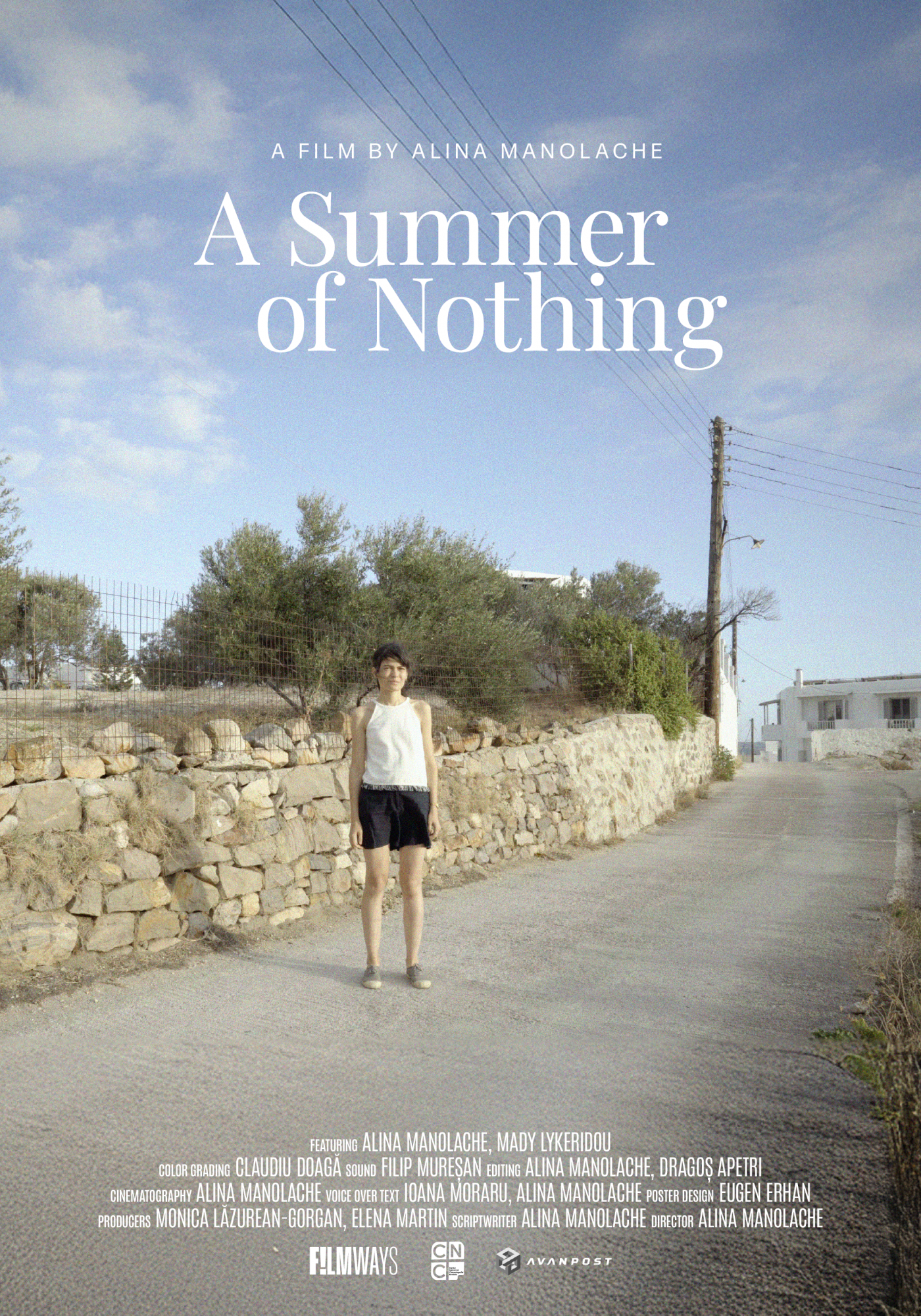
A Summer of Nothing — documentary feature, 2026
A quest for nothing inevitably leads to everything.
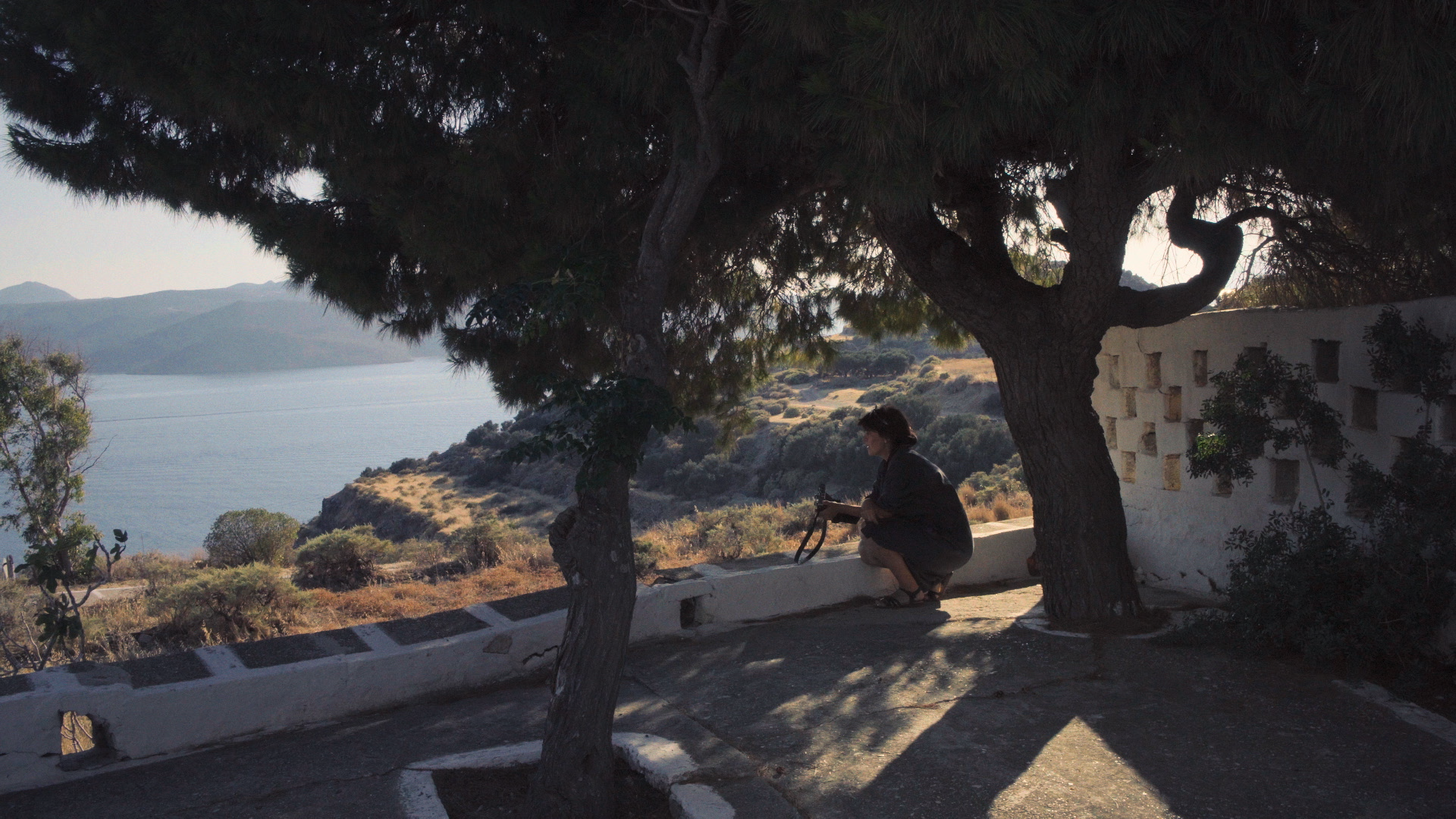
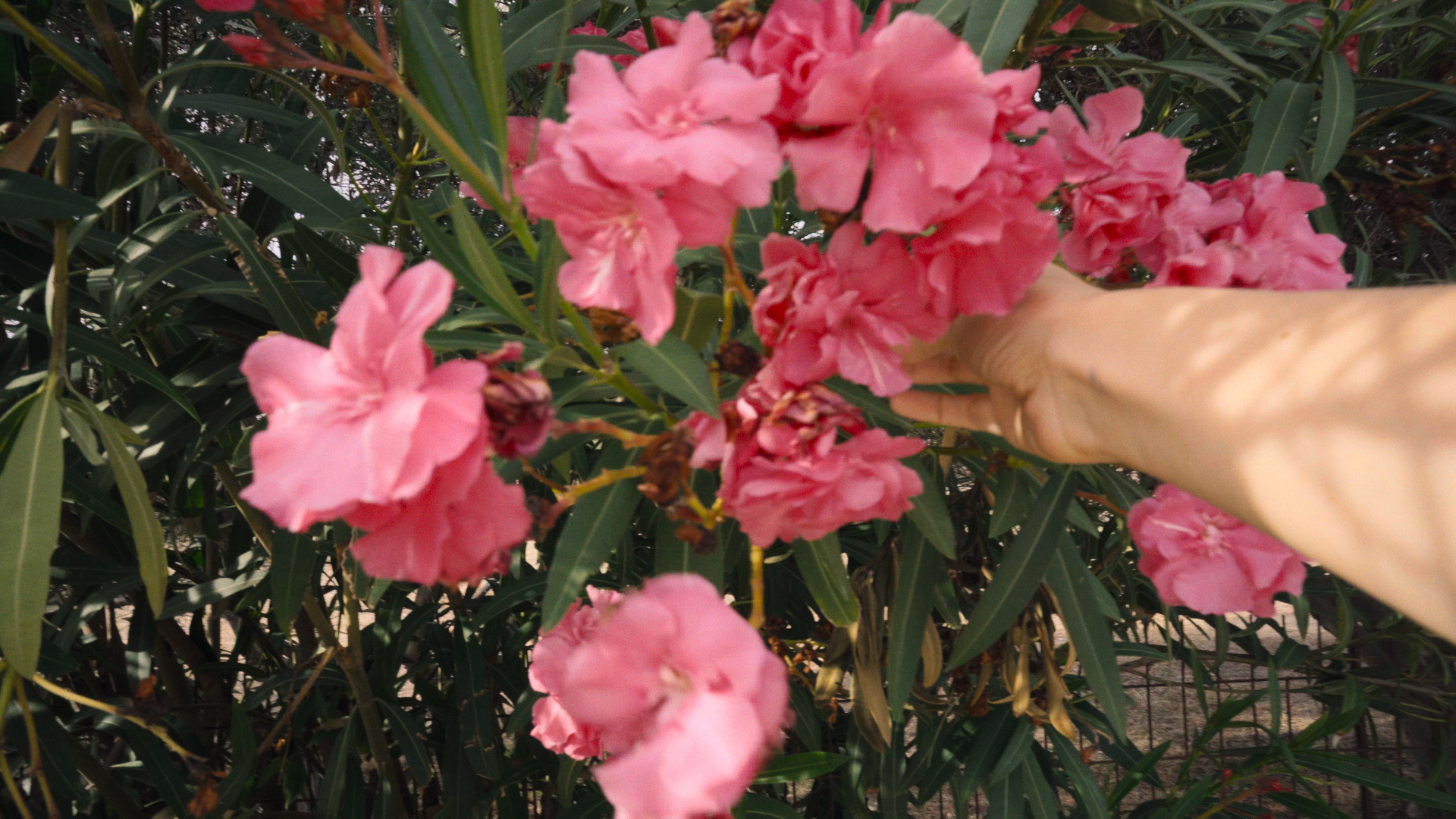
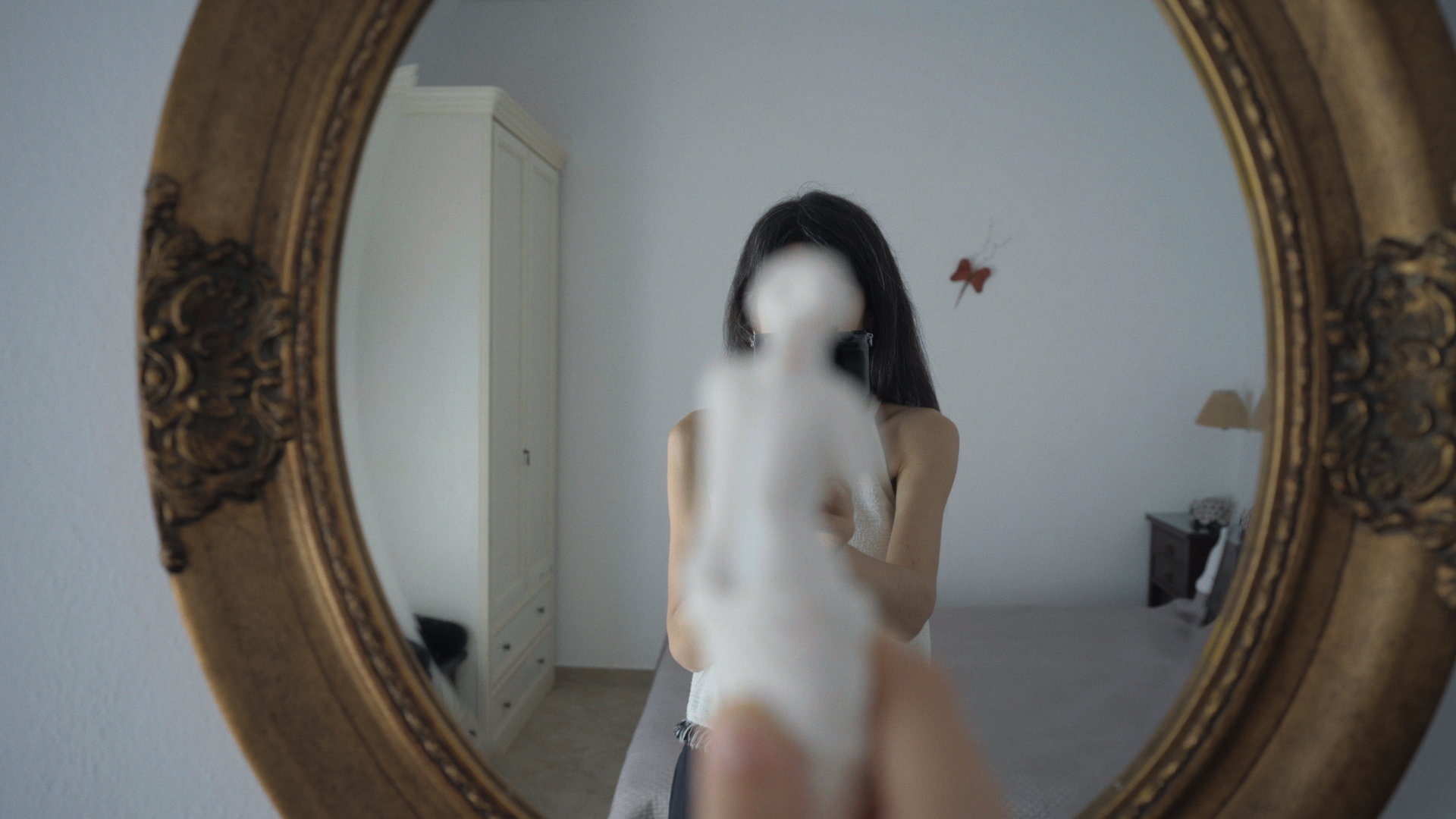
A personal essay at the intersection of a diary and a self-portrait, A SUMMER OF NOTHING, director Alina Manolache’s second feature film, offers a candid reflection on the millennial experience – a generation for whom doing, producing, and succeeding have become almost synonymous with existing – drawing from a personal experience from the year when she turned thirty. In the midst of an unprecedented global crisis, having arrived on a Greek island to film the repatriation of the Venus de Milo sculpture, the director discovers that the film she had envisioned can no longer be made. Faced with the reality of a failure attributed to forces beyond her control, she devotes herself to an unexpected exercise – that of doing nothing. In a world turned upside down, where the pressure of one’s own expectations is even greater than the capitalist imperative of productivity – against which Melville’s clerk Bartleby once rebelled with his famous “I would prefer not to” – the author realizes that her experiment is more difficult than she had initially imagined. In one of the film’s most vivid sequences, an attempt at guided meditation brings to the surface an anecdotal madeleine hidden deep within her memories of her childhood in the 1990s. The image of a child, exhausted by the pressure to perform, who skips piano class to sleep on a bench in the shade of a blossoming tree – and inevitably ends up crying with shame when discovered – becomes the corollary to a broader meditation on the constant negotiation between the roles we assume and our own needs – at work, in love, and in our relationships with others. Doing nothing becomes here a discreet act of resistance: an attempt to reclaim time and the self from the logic of performance and to accept, if only for a moment, that simply existing need not be an achievement – a sentiment with which many viewers of the same generation will resonate.
Oana Ghera, BIEFF
Next screenings
Cinema Union, Bucharest, Special screening, 17.10.2026 – Tickets
Cinema Arta, Cluj-Napoca, Premiere, 17.10.2026 – Tickets
Cinema Elvire Popesco / The French Institute, Gala premiere, 16.10.2026 – Tickets
BIEFF, Romania, 24.09.2026, Special preview
Cast & Crew
Cast: Mady Lykeridou-Veletas, Gerasimos Damoulaki, Zambeta Tourlou, George Veletas, Antonis Lykeridou-Veletas, Xrysa Lykeridou-Veletas, George Lykeridou-Veletas, Gabi Basalici, Athanasia Psatha, Margarita Poulaki, Xrysoula Tsouda, Fratzeska Ninou, Marianthi Ninou, Emmanouela Vichou, Katerina Ventouri.
Director, writer: Alina Manolache
Producers: Monica Lăzurean-Gorgan, Elena Martin
Editing: Alina Manolache, Dragoș Apetri
Sound design and original music: Filip Mureșan
Voice over text: Ioana Moraru, Alina Manolache
Grading: Claudiu Doagă
Grading consultant: Laurențiu Răducanu
Poster design: Ciprian Moraru
Subtitles: Anca Bărbulescu
Trailer: Dragoș Apetri
Distribution: Oana Ghera, Diana Smeu
Communication and press: Alexandra Apețean
Director’s statement
‘In attempting to give a gift of almost Nothing, I almost make Nothing of it all. For from this almost Nothing, I have very nearly recreated the entire Universe, which contains everything!’ – Johannes Kepler
Essentially, out of nothing, we’ve made a film about being young in today’s world, and asking life’s biggest questions. We have asked a lot of questions through this film. Existential questions like, Who am I? What do I want, and what does society want from me? A lot of work-related questions – like, What is the meaning of work and why does my work ask so much from me? Who pushes the acceleration buttons? What happens when you abandon society’s expectations of achievement – and your own? Can the pursuit of nothing be an act of protest in a culture that worships productivity? And, finally, questions about human connection or lack of – What is the meaning of friendship and relationships, and what is the meaning of solitude?(probably these are a side effect of the then-recent pandemic). Many of the questions were left unanswered, and the character Alina remains incomplete. But I think that is the value of the experiment and of the film itself. It starts the engines of a train of thought that continues in you, long after the credits roll. “The film is finished, but there is still room to dream”, as David Lynch would say. I am well aware that the film addresses generational topics and concerns, like the role of the internet in our lives, or the pressure to overperform at work. But I do hope that it will resonate inter-generationally, via the space for reflection it opens around the conundrum of being human.